
How Prop Trading Works (Guide 2026)

Prop trading firms provide traders with access to company capital – How Prop Trading Works?
Instead of risking your own large account, you pay an evaluation fee to prove your skills.
Most prop firms generate revenue from evaluation fees, but their long-term success depends on funded traders performing consistently. Risk management rules such as daily drawdown, maximum loss, position limits, and consistency requirements help firms protect their capital.
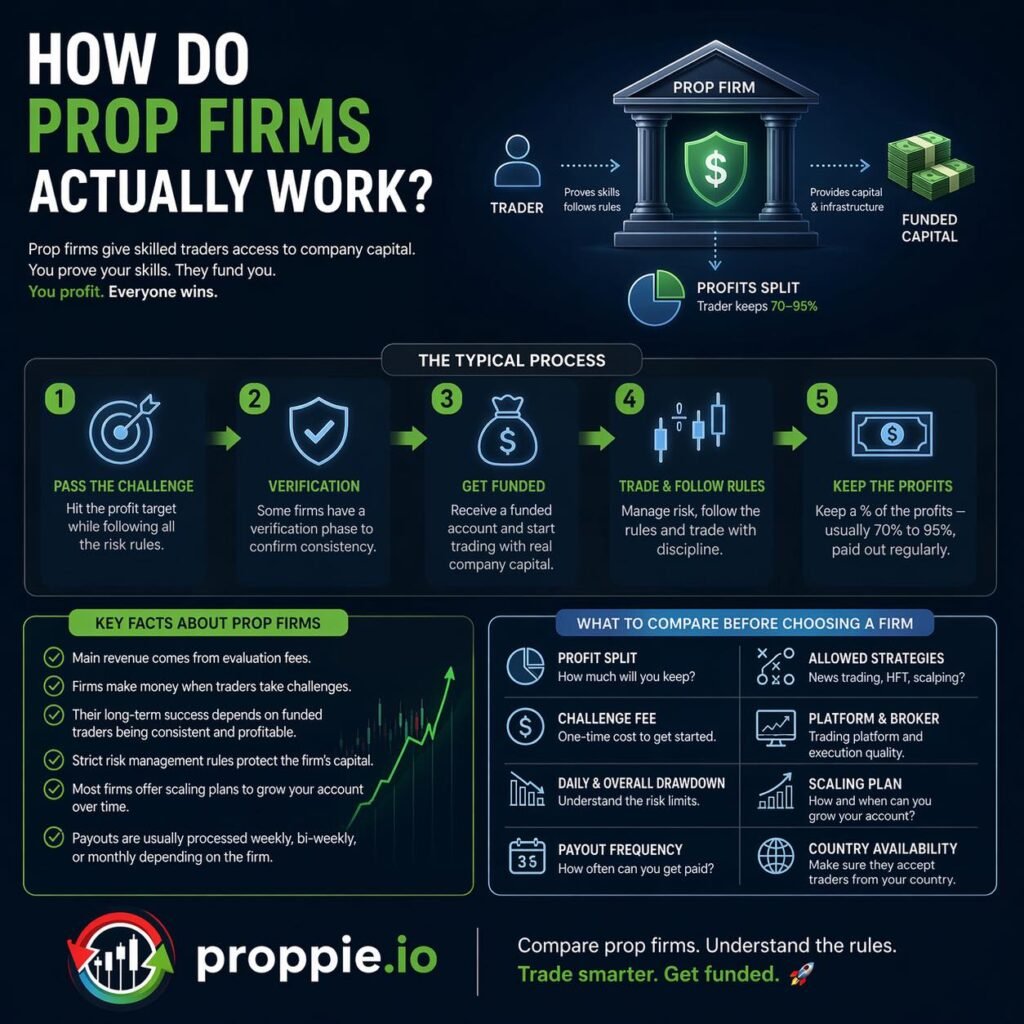
Not all prop firms are created equal. Understanding the rules is just as important as your trading strategy.
Pricing Models in Prop Trading
Prop firms do not use a single pricing structure. Instead, there are multiple models that affect how much traders pay and what they receive in return.
Some firms offer low entry fees, which make it easy to start. However, these models often include additional costs later, such as paid resets, scaling fees, or upgrades for higher account sizes.
Other firms use a higher upfront fee but include everything in one package. In these cases, traders usually get full access to scaling programs without additional payments.
Typical pricing structures:
- Low entry fee + optional paid upgrades
- Higher upfront fee + all-inclusive funding path
- Subscription-based models (monthly cost)
- One-time challenge fee with scaling included
Profit Splits (50:50 to 90:10)
One of the most important aspects of prop trading is how profits are shared between the trader and the firm.
Profit splits vary widely depending on the firm and trader performance.
Typical structures include:
50:50 → often entry-level or higher-risk models
70:30 → industry standard
80:20 → competitive modern firms
90:10 → top-performing traders or premium accounts
Some firms also increase profit splits over time based on consistency and performance history.
Why Profit Splits Differ
Higher profit splits usually come with stricter evaluation rules, tighter risk controls, or higher entry costs.
Lower profit splits often come with easier entry but fewer long-term benefits.
Consistency Rules Explained
Consistency rules are one of the most important (and misunderstood) parts of prop trading.
Their purpose is to ensure that traders do not pass evaluation phases using a single high-risk trade or random luck. Instead, firms want to see stable, repeatable performance.
In practice, this means that traders may need to distribute profits across multiple days or avoid situations where one trade accounts for most of the total profit.
Different firms define consistency differently. Some are strict and mathematically precise, while others are more flexible and focus mainly on overall profitability and drawdown compliance.
What Happens After You Pass?
Once you successfully pass the evaluation process, you receive access to a funded account. At this stage, you are trading real capital provided by the firm under live market conditions.
From this point, your earnings depend on performance. You receive a percentage of the profits generated, and withdrawals are usually processed on a weekly or monthly basis.
Many firms also offer scaling programs that increase your account size over time if you maintain consistent profitability and low risk exposure.Once you successfully pass the evaluation process, you receive access to a funded account. At this stage, you are trading real capital provided by the firm under live market conditions.
From this point, your earnings depend on performance. You receive a percentage of the profits generated, and withdrawals are usually processed on a weekly or monthly basis.
Many firms also offer scaling programs that increase your account size over time if you maintain consistent profitability and low risk exposure.
Risks of Prop Trading
While prop trading offers access to large capital, it is not guaranteed income. Traders must operate under strict rules, and failure rates in evaluation phases are high.
Common challenges include:
- strict risk enforcement
- psychological pressure during evaluation
- inconsistency penalties
- difficulty maintaining long-term performance
Success depends heavily on discipline, risk management, and strategy consistency.
How to Choose the Right Prop Firm
Before selecting a prop firm (now you know how prop trading works), it is important to compare:
- pricing structure (including hidden costs)
- profit split model
- evaluation difficulty
- consistency rules
- drawdown limits
- reputation and payout reliability